Guide
How to start a podcast studio
To start a podcast studio, find a quiet room you can treat and reach easily, equip it so a guest can sit down and record without fiddling, and decide what you sell besides the room: an engineer, editing, video. Then make it easy to find, book and pay, and win your first regulars one by one.
1. Who rents a podcast studio
Before you sign a lease, know who you are building for. The clients usually fall into a few groups, and each wants something a little different:
- Independent podcasters who record at home but want better sound, a neutral place for guests or a regular weekly slot
- Companies recording internal or marketing podcasts, webinars and interviews, who want everything to work without their own technician
- Video podcasters, who need light, a set and several cameras as much as good audio
- Agencies, production companies and freelancers who book for their clients and come back often
- One-off bookings: audiobook samples, voice-overs, a radio interview recorded remotely
2. Choosing the space
The room matters more than the equipment: a good microphone in a noisy, echoing room still sounds bad. Look at it with your ears first.
- Outside noise: traffic, a bar downstairs, a lift shaft, ventilation. Visit at the times you plan to sell and listen with the windows closed.
- Isolation is expensive to add later. Solid walls, a heavy door and no shared thin partition save you from building a room inside a room.
- Size: a room for two to four people around a table, plus space for a camera and lights if you plan video. Very small rooms are hard to make sound good.
- Access: easy to find, near public transport or parking, step-free if possible, and usable early mornings and evenings without depending on someone else's opening hours.
- Power, a stable internet connection and a place to sit and wait outside the recording room.
3. The basic setup
Keep it simple and repeatable: every guest gets their own microphone on a stand or arm, their own headphones, and the recording runs through one interface, mixer or recorder that you know well. Treat the room against echo before buying more expensive microphones. If you plan video, add soft, even light, a backdrop with some depth and a camera for the wide shot and one per speaker.
Write down how the setup should look when a session starts, so it is the same every time. The design and equipment guide goes through acoustics, layout and each category of gear.
4. Services, packages and pricing
Decide what you sell besides the hour in the room. Clear packages make it easier for a new client to choose, and they let people who only need the room pay for the room alone.
Price the room by the hour from your costs and a realistic number of booked hours, not from what you hope to sell in a good month. Set a minimum length that covers your reset time, and price an engineer, editing or video on their own, so the room doesn't look expensive to people who only need the space. Evenings and weekends usually fill first and can carry a higher rate; the guide on pricing a studio by the hour goes through the method with a worked example. Common packages:
- Self-service recording: the room and the setup, the client records and takes the files
- With an engineer: someone sets up, watches the levels and solves problems during the session
- Editing and mastering afterwards, priced per finished episode or per hour of work
- Video: cameras, light and a set, with or without an operator and the edit
- A regular slot for weekly shows, or a pack of hours for companies and agencies
5. Bookings, payments and access
Messages back and forth about free times lose bookings. Let clients see the free times, book and pay online, and get a confirmation with the address and what to bring. Taking payment at booking means no chasing invoices and fewer no-shows; a written cancellation policy says what happens when plans change.
If you won't be there for every session, each booking needs its own way in that works only for its time, and someone the client can call when something goes wrong. The guide on running an unstaffed studio covers access, house rules and reset time.
6. Getting found and the first clients
People look for a podcast studio when they need one, usually by searching for it with the name of their town. Make sure you show up there:
- Your own website with clear photos of the room, the equipment, what each package includes, the prices and a way to book
- A Google Business Profile with the right address, opening hours, photos and a link to booking; ask happy clients for a review
- Pages people search for: "podcast studio" and "video podcast studio" with your town's name in titles and text
- Your network first: local podcasters, companies you know, coworking spaces, agencies and freelance editors
- A sample: record a short episode or a clip in the studio so people can hear and see the result
Doing this in Ruumio
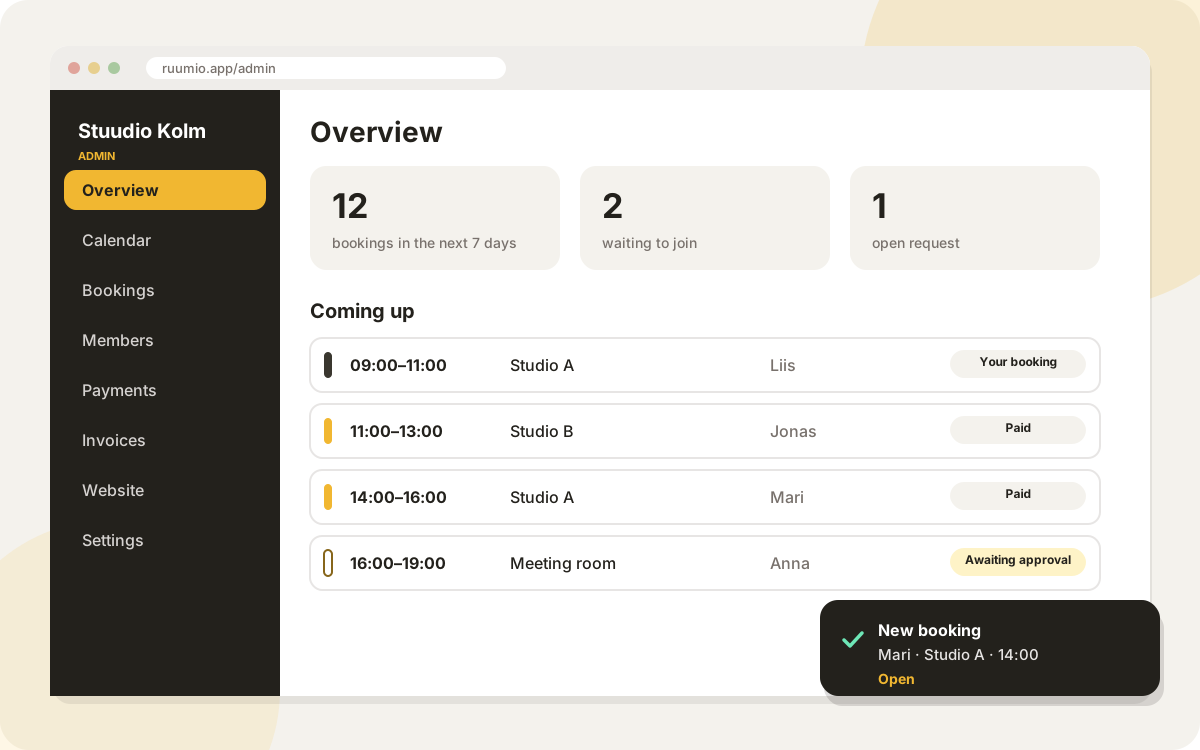
Every studio on Ruumio gets a website with its rooms, equipment, prices and a booking calendar on the page, in the languages you choose. Clients book their own start and end time within your opening hours and pay by card through your own Stripe account; guests can book without an account if you allow it, and weekly shows can book a recurring series in one go. Each page has its own title and description for search engines, and the site has a sitemap and structured data with your address. Standard and Pro add your own domain and reviews collected after sessions.
An engineer, editing or a video package can be offered as booking extras (Standard and Pro), priced per hour or per booking and limited to what you can supply at once; staff accounts get assigned to the sessions that need them. Each room has its own minimum length, buffer and cancellation policy, and with the door codes add-on every booking gets its own UniFi Access code, valid only around its time.
Questions
Do I need a soundproof room to start?
You need a room that is quiet enough at the times you sell and treated against echo. Full soundproofing is costly; choosing a space with solid walls and little outside noise is usually cheaper than fixing a noisy one.
Should I offer video from the start?
Only if your clients ask for it. Video needs light, cameras, a set and more space, and an edit takes time. Many studios start with audio and add a video package once regulars ask.
Do I need an engineer at every session?
No. Many clients are happy to record on their own in a room set up the same way every time. Offer an engineer as an extra for those who want one.
How do I get my first clients?
Start with people you can reach directly: local podcasters, companies and agencies. Show them the room with a sample recording, make booking easy and ask the first clients for a review.
Updated 25 October 2026
Try Ruumio free for 14 days
No credit card needed. Your own website and booking calendar in a few minutes.
Create your studio