Comparison
Ruumio vs Podyx
Podyx suits a podcast studio that sells each room as several setups with services and add-ons, works with podcast guests and delivers files to clients; Ruumio suits studios and rooms of any kind rented by the hour that want their own website, card payments with VAT invoices and door codes in one place. Both take bookings with rules, card payments to the studio's own account and packages for regulars. This page sticks to what Podyx's own help center and pricing page say.
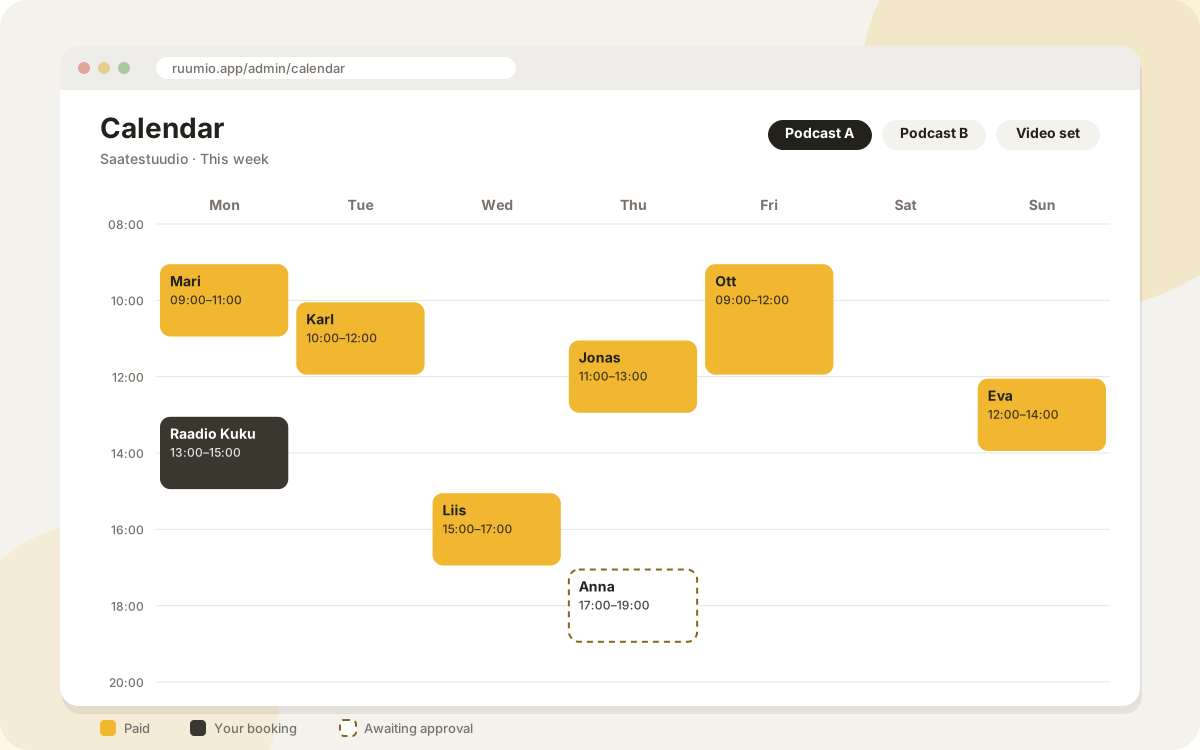
Two tools built for studios
Podyx describes itself as booking and operations software for podcast studios, and also pitches the same model to music, photo, production and event spaces. It sells a room in four layers: the room itself, never shown to clients; setups, the versions of a room that clients see and book; base services, usually the session; and add-ons. Booking any setup blocks the whole room for that time.
Ruumio sells time in a room. Each room shows bookers its description, capacity and equipment, and has its own rules and prices, and extras such as a sound engineer or a camera, priced per hour or per booking and limited to how many you have across all rooms. Booking questions ask what you need to know, such as how many people are coming.
Booking rules
Podyx's help center lists a minimum and maximum session length, a time step, a buffer after each booking, and separate cutoffs for booking, cancelling and rescheduling, set for the studio and overridden per room or setup. Clients can reschedule or cancel themselves within those cutoffs.
In Ruumio each room has its opening hours, time step, shortest and longest booking, how far ahead people can book, a cancellation deadline and a buffer before and after every booking. Closures apply to one room or all of them, recurring series skip dates already taken, and extras can need your approval on the weekdays you choose. Clients can cancel within your policy but don't move a booking themselves: they cancel and book again.
Payments, refunds and invoices
Podyx connects to the studio's own Stripe account or to Square, or takes requests to pay later. Its help center says money refunds are always for the full amount and partial amounts go back as store credit. Invoicing is on its Premium plan; credit notes are not mentioned in its help center.
Ruumio takes card payments through Stripe into the studio's own account. Cancellations are refunded to the card by your policy, in full or in part, and the owner can also refund part of a payment by hand. Every payment gets an invoice and every refund a credit note, with VAT, on every plan, and companies can book on account and get one invoice a month.
Packages for regulars
Podyx's pricing page lists bundles of sessions on every plan, and subscriptions, store credits and promo codes on Premium. Its bundles have their own landing pages and tiers where buying more lowers the price per session.
Ruumio counts hours rather than sessions: member plans give hours per room each month (Standard and Pro), hour packs are spent minute by minute (Pro), and gift cards (Pro) and discount codes (Standard and Pro) come off the price on their own. A cancellation gives back the matching share of hours.
What Podyx does that Ruumio doesn't
Podyx is built around the podcast session. Clients add their show's guests at booking, each guest gets their own calendar invite, and the studio keeps a guest database with notes. Clients choose a file delivery method at checkout, free or paid, and an early-access video review lets them comment on a recording with timestamps. A separate studio tour booking takes prospects who aren't ready to book.
It also syncs both ways with Google Calendar, takes Square and pay-later requests, and has a dashboard of revenue and room use on Premium. Ruumio has none of these podcast-specific parts; its reports (Standard and Pro) show bookings, booked hours, how full each room was and the income.
Website, languages and the door
Podyx gives each studio a landing page with a hero image, reorderable sections and a custom domain, and embeds on Premium. Ruumio gives each studio a whole website with a page builder and templates on every plan, plus a booking widget for a site you already have and booking links to share.
Podyx's booking site and e-mails are available in 11 languages. Ruumio offers visitor pages and e-mails in 26 languages, and you translate your own texts per language. Podyx's pages don't mention door access; Ruumio's UniFi Access add-on gives every booking its own PIN that works only during the booking.
Which one fits
Podyx fits a podcast or video studio whose sales revolve around setups, add-ons, guests and file delivery, and that wants Square or two-way Google Calendar. Ruumio fits a studio, rehearsal space or room rental with one room or many that wants its own website, VAT invoices and credit notes, regulars with prepaid hours and clients who let themselves in.
Podyx's plans include two or four rooms and one location, with more on request; Ruumio's plans include one, five or ten rooms, more can be added, and rooms can be grouped by location on every plan. Podyx's trial is 30 days; Ruumio's is 14 days, and neither asks for a card to start.
| Ruumio | Podyx | |
|---|---|---|
| Built for | Studios and rooms of any kind rented by the hour | Podcast studios, also pitched to music, photo, production and event spaces |
| What clients book | A room, with extras | A setup of a room, with a base service and add-ons |
| Clients reschedule themselves | No: cancel within the policy and book again | Yes, within the cutoffs |
| Payment providers | Stripe, to your own account | Stripe or Square, or pay later |
| Partial refunds | To the card, by your policy | As store credit; money refunds in full |
| Invoices | Every plan, with VAT; credit note for every refund | Premium; credit notes not mentioned |
| Prepaid regulars | Member plans with hours, hour packs, gift cards | Bundles; subscriptions and credits on Premium |
| Website | Full website with page builder, templates, own domain | Landing page with custom domain; embeds on Premium |
| Calendar sync | iCal feeds out, outside iCal calendars read in | Two-way Google Calendar |
| Podcast guests, file delivery, video review | No | Yes (video review in early access on Premium) |
| Door code per booking | UniFi Access (add-on) | Not on its public pages |
| Languages | 26 | 11 |
| Rooms and locations in a plan | 1, 5 or 10 rooms, more can be added; locations on every plan | 2 or 4 rooms, 1 location; more on request |
Facts about other products checked on 18 October 2026 from their public pages:
- Podyx: pricing
- Podyx Help Center: welcome to Podyx
- Podyx Help Center: booking rules
- Podyx Help Center: rooms
- Podyx Help Center: setups
- Podyx Help Center: how a booking works
- Podyx Help Center: connect your payments
- Podyx Help Center: payments and refunds
- Podyx Help Center: invoicing
- Podyx Help Center: bundles
- Podyx Help Center: subscriptions
- Podyx Help Center: connect Google Calendar
- Podyx Help Center: guests
- Podyx Help Center: file transfer
- Podyx Help Center: collaboration
- Podyx Help Center: studio tour
- Podyx Help Center: build your landing page
- Podyx Help Center: automated e-mails and notifications
Questions
Is Ruumio only for podcast studios?
No. Ruumio is built for any room rented by the hour: podcast, music and photo studios, rehearsal rooms and meeting rooms. Podyx is built for podcast studios first.
Does Ruumio have setups like Podyx?
No. In Ruumio a client books a room and can add extras, such as a camera or a sound engineer, limited to how many you have. If you sell one room as several sets with their own photos and services, Podyx's setups are built for that.
Can my clients move a booking themselves?
Not in Ruumio: they cancel within your cancellation policy and book a new time, and the refund follows the policy. An admin can cancel with a full refund when a move is agreed.
Can I bring my bookings over from Podyx?
Ruumio has no automatic import from Podyx. You set up rooms, hours and prices in the admin, and your clients make an account or book as guests.
Updated 25 October 2026
Read next
- For studiosBooking software for podcast studios
- FeaturesYour studio's own website, with booking built in
- FeaturesInvoices and credit notes that issue themselves
- FeaturesA door code for every booking, with UniFi Access
- FeaturesYour site, booking and e-mails in your guests' languages
- CompareSkedda alternatives for studios
Try Ruumio free for 14 days
No credit card needed. Your own website and booking calendar in a few minutes.
Create your studio