Guide
How to price a studio or room by the hour
Start from what an hour costs you at a realistic occupancy, add the margin you need, and check the result against what your clients compare you with. Then shape the price list: peak and off-peak rates, a minimum length, half and full days, extras priced on their own and packs for regulars.
1. Work out your cost floor
Your hourly price has to cover what the studio costs whether it is booked or not. Add up a normal month, not your best one. Count everything that leaves your account because the room exists:
- Rent, common area charges, utilities and internet
- Equipment: what you paid divided by how many months it will last, plus repairs and replacements (cables, headphones, lamps)
- Insurance, software, bookkeeping and bank costs
- Cleaning and resetting the room, whether you do it yourself or pay someone
- Staff time that isn't sold separately: answering messages, letting people in, handing over
- Card processing fees, which are usually a share of each payment, so they grow with the price
2. Divide by the hours you will actually sell
The mistake most new studios make is dividing their costs by every hour the room is open. No room is booked all the time. Utilization is the share of your opening hours that is booked, and early on it is often low. Pick a figure you can defend from your own bookings or inquiries, and work out the price at a lower one too, so a slow month doesn't put you underwater.
Your break-even hourly rate is your monthly costs divided by the hours you expect to sell. Add the profit you want on top, and add the card fee back in, since it is taken from the price itself.
3. A worked example (hypothetical numbers)
These figures are made up to show the method, not a guide to what studios charge. Say a one-room studio costs $2,500 a month in total. It is open 10 hours a day, about 300 hours a month, and the owner expects to sell around 80 of them (roughly 27 % utilization).
Break-even is $2,500 ÷ 80 = about $31 an hour. To also earn $1,000 a month, the studio needs $3,500 ÷ 80 = about $44 an hour, before card fees. Rounded up, that's $45. At 60 sold hours the same $45 still covers the costs ($2,700), but the profit shrinks to a couple of hundred dollars. Running both numbers tells you how much room you have before a slow month becomes a loss.
4. Check the market, then shape the price list
Once you know your floor, look at what your clients would otherwise do: another studio in town, a home setup, a coworking meeting room. You don't have to be the cheapest; you have to be worth it to the people you want. If your floor is above what they will pay, change the costs or the offer, not just the price.
Then decide the shape of the price list:
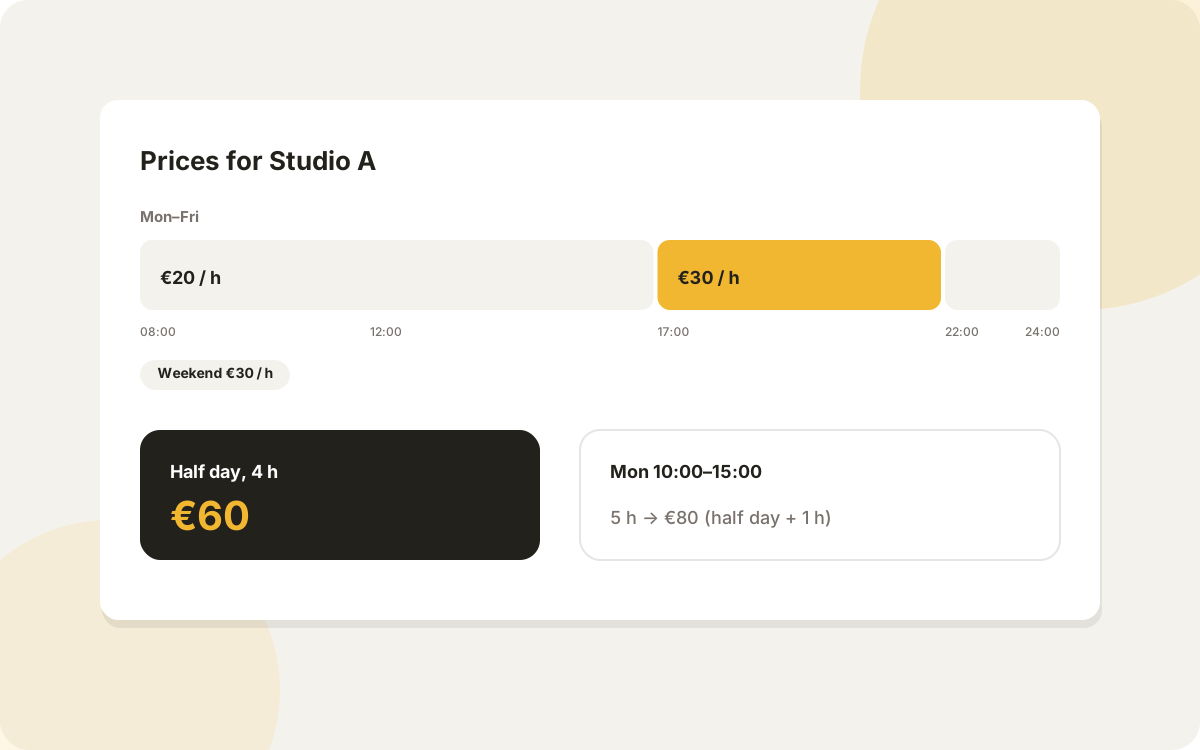
- Peak and off-peak: evenings and weekends usually fill first. Charge more there and less for quiet daytime hours, so the room earns more without turning away people who are flexible.
- Minimum booking length: a 30-minute booking costs you a full reset. Set a minimum (one or two hours is common for recording) and a time step that matches how people book.
- Half-day and full-day blocks: a lower price for four or eight hours rewards long sessions, which cost you less in turnovers. Make sure the block is always cheaper than the same hours at the hourly rate.
- Later hours cheaper: instead of a block, keep the first hour at the full rate and take a percentage off every further hour of the same booking, for example 10 % from the second hour and 20 % from the fifth. Long sessions get cheaper hour by hour without a fixed block length.
- A buffer between bookings: time to reset the room that you don't sell. It lowers your sellable hours, so include it in the utilization figure.
5. Price extras separately
An engineer, a photographer, a second camera, editing afterwards: these have their own costs and not everyone wants them. Folding them into the room price makes the room look expensive to people who only need the space. Price them per hour when the cost grows with time (a person), per booking when it doesn't (setting up a backdrop), and keep an eye on what you can actually supply at the same time.
6. Packs and plans for regulars
Regulars are worth a lower price because they fill the calendar without marketing. Two common forms: an hour pack (for example ten hours paid up front at a discount, valid for some months) and a monthly plan with a set number of hours included. Price both from your hourly rate, keep the discount clearly smaller than your margin, and set an expiration date so prepaid hours don't hang over you for years. The guide on turning regulars into members goes deeper.
7. Test and adjust
A price is a guess until people book at it. Review it on a fixed rhythm, for example every quarter:
- Look at utilization by weekday and hour. Times that are always full can carry a higher rate; times that are always empty need a lower rate or a different offer.
- Count inquiries that end without a booking and ask why, when you can.
- Change one thing at a time and give it a few weeks, so you can tell what made the difference.
- Announce increases ahead of time and honor bookings, packs and plans already paid at the old price.
Doing this in Ruumio
Each room has its own hourly price, time step, minimum and maximum length and a buffer before and after every booking that isn't charged. On every paid plan you can add peak and off-peak rates by weekday and time, and block prices such as half a day or a full day. A booking is always charged the cheaper option, and the invoice shows each part separately. Pricing rules (Standard and Pro) add percentage discounts and surcharges, among them tiered hours: the first hours of a booking at full price and the later ones cheaper, in one or two tiers, shown in the room's price list. Bookers see the same price in the booking form before they pay.
Booking extras (every paid plan) are priced per hour or per booking, can be limited to how many you have at the same time, and are charged even when plan or pack hours cover the room. Standard and Pro can also sell hour packs and monthly plans with hours per room. If your state taxes what you sell, you set your sales tax rate and mark rooms, services and extras as taxable; the tax is added at checkout and shown on its own line of the invoice.
Reports (every paid plan) show booked hours, utilization against opening hours per room, card revenue and the busiest weekdays and hours, so you can see which times can carry a higher rate.

Questions
Should I show prices with or without sales tax?
In the US, prices are usually shown before sales tax, which is added at checkout. Whether studio or room rental is taxable depends on your state and sometimes your city, so check your state's sales tax rules or ask your accountant.
How often should I raise my prices?
There is no fixed rule. Review the figures regularly, raise prices when your costs rise or your popular hours are always full, and give clients notice. Keep packs and plans already bought at the price they were bought at.
Is it a good idea to be the cheapest studio in town?
Only if your costs really are the lowest. Being cheapest attracts price-driven clients who leave for the next offer, and it leaves no margin for repairs or slow months.
Should a block price be cheaper than the hours it replaces?
Yes, otherwise nobody chooses it. A long booking also saves you turnovers and resets, which is where the discount comes from.
Updated 23 November 2026
Ruumio is coming to the United States
We're opening state by state. Join the waitlist and we'll invite you as soon as your state opens.
Join the waitlist